Organize your ideas before you start writing by giving yourself permission to slow down before you begin.
Have you ever sat down with a hot cup of coffee, opened your laptop, and thought, “I know exactly what I want to write”—only to end up staring at a blank screen?
Your head is full of ideas. You have examples, stories, facts, and random thoughts all bouncing around in your mind. But the moment your fingers touch the keyboard, everything suddenly feels tangled together.
One idea leads to another. You wonder which point should come first. You type a sentence, delete it, and start over. Before long, you’re looking at a blinking cursor and wondering why writing feels so difficult.
If you’ve ever felt this way, you’re not alone.
When I was a student, I thought I needed to know exactly what I wanted to say before I started writing. Looking back, I realized that wasn’t the problem at all. The real challenge was trying to hold every idea in my head at the same time.
The good news is that learning to organize your ideas before you start writing doesn’t require a complicated system. A few simple techniques can help you clear the mental clutter, build a plan, and make writing feel much less overwhelming.
Let’s start with the method that has helped me more than any other.
1. Organize Your Ideas Before You Start Writing with a Brain Dump
One of the easiest ways to organize your ideas before you start writing is to stop trying to organize them for a few minutes.
Instead, begin with a brain dump.
Grab a notebook, open a blank document, or even use the notes app on your phone. Write down every idea that comes to mind without worrying about grammar, spelling, punctuation, or whether the idea belongs in your final draft.
Write down facts, questions, quotes, statistics, examples, or even ideas that are only a few words long.
The goal isn’t to write something polished.
The goal is simply to empty your mind.
Our brains can only keep track of so many thoughts at one time. Once those ideas are written down, your brain no longer has to remember everything. Instead, it can focus on making connections and seeing patterns.
Don’t edit yourself during this step.
Don’t rearrange anything.
Don’t worry if your page looks messy.
In fact, if it looks a little chaotic, you’re probably doing it right.
2. Use Index Cards to Organize Your Ideas Before You Start Writing
If you’re trying to organize your ideas before you start writing, index cards are one of the simplest tools you can use. Now that you’ve completed your brain dump, it’s time to begin organizing your thoughts.
Take a stack of index cards and write one main idea on each card.
Only one.
Keeping a single idea on each card makes it incredibly easy to move your thoughts around until they begin making sense.
Spread the cards across a table where you can see everything at once.
You’ll quickly notice that certain ideas belong together while others need to be moved.
Some cards may become section headings.
Others become supporting details.
You may even discover that two ideas are saying the same thing and can be combined into one stronger point.
I love this method because nothing feels permanent. You’re free to experiment without worrying about deleting paragraphs or rewriting entire sections.
Think of your index cards like puzzle pieces.
You’re simply discovering where each one belongs.
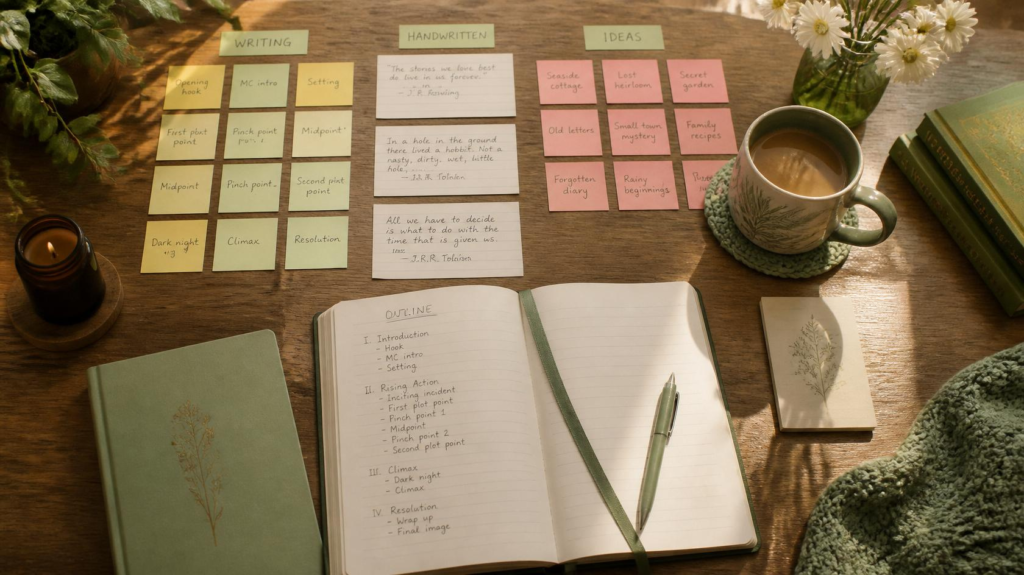
3. Organize Your Ideas Before You Start Writing with Color-Coded Sticky Notes
Out of everything I tried in college, this was the method that helped me the most.
I’m a visual learner, so I needed to see my ideas instead of trying to organize them in my head.
That’s when I started using color-coded sticky notes.
I gave each color a different purpose.
- Yellow for main ideas
- Green for supporting details
- Blue for research or important facts
- Pink for examples, stories, or quotes
Then I’d stick them on a wall, a poster board, or spread them across my desk.
Seeing everything laid out in front of me completely changed the way I approached writing.
Instead of feeling overwhelmed, I could immediately see which ideas belonged together, which sections needed more information, and which thoughts didn’t really fit.
I still think this is one of the easiest ways to organize your ideas before you start writing, especially if you’re a visual thinker.
Even today, I find myself reaching for sticky notes whenever I need to make sense of a large project.
Sometimes the simplest tools really are the most effective.
4. Turn Your Organized Ideas into a Simple Outline
Once you’ve taken the time to organize your ideas before you start writing, creating an outline becomes much easier.
Don’t overthink this step.
Your outline doesn’t have to be complicated.
It can be as simple as:
- Introduction
- Main Point One
- Main Point Two
- Main Point Three
- Conclusion
Under each heading, place the ideas you’ve already grouped together.
At this point, you’ve already completed the hardest part.
You’re no longer facing a blank page.
You’re simply following a roadmap you created yourself.
5. Create an Idea Parking Lot
Here’s one more trick that has helped me stay focused over the years.
If you’re trying to organize your ideas before you start writing, creating an Idea Parking Lot can help you stay focused without losing great ideas that pop into your head.
Keep one extra sheet of paper beside you labeled Idea Parking Lot.
As you begin writing, your brain will almost certainly think of something unrelated.
Maybe it’s another article idea.
Maybe it’s a statistic you want to research later.
Maybe it’s something completely unrelated that suddenly pops into your head.
Instead of stopping your writing session, jot the idea down in your parking lot and immediately return to your draft.
Your brain relaxes because it knows the idea isn’t lost.
Meanwhile, your writing keeps moving forward.
6. Don’t Wait for the Perfect First Sentence
One of the biggest mistakes writers make is believing they have to begin with the introduction.
You don’t.
If you know exactly how to explain your second point, write that first.
If your conclusion comes to mind before your introduction, write it.
Many experienced writers actually save the introduction until the end because it’s much easier to introduce a topic after they’ve finished writing about it.
Remember…
Progress will always beat perfection.
☕️ Clarity Tip
If you’re trying to organize your ideas before you start writing and your thoughts feel like twenty browser tabs open at once, stop trying to write the perfect paragraph.
Instead, ask yourself one simple question:
“What’s the one thing I want my reader to understand?”
Write that idea down first. You can always improve your wording later, but you can’t edit a blank page.
Final Thoughts
Learning to organize your ideas before you start writing isn’t about finding one perfect method.
It’s about finding the process that works best for you.
Some writers love brain dumps.
Others prefer index cards.
For me, color-coded sticky notes made all the difference because I could finally see my ideas instead of trying to remember them.
No matter which method you choose, remember that every great article, essay, research paper, and book started as a collection of scattered thoughts.
The writers who finish aren’t the ones with the best ideas.
They’re the ones who have a system for turning those ideas into words.
The next time you sit down with a cup of coffee and a blank screen, don’t worry about writing the perfect first sentence.
Simply organize your ideas first.
The writing will become much easier.
Related Writing Tools
If you’re ready to organize your ideas before you start writing, these free writing tools can help you plan, draft, and polish your work more efficiently.
Word Counter
After you’ve organized your ideas, it’s time to start writing. Our Word Counter lets you quickly track your progress so you can stay within assignment requirements, article goals, or manuscript targets without interrupting your workflow.
Words to Pages Calculator
Wondering how long your paper will be? Our Words to Pages Calculator estimates how many pages your writing will fill based on your word count, font size, and spacing, making it helpful for essays, reports, and assignments.
Reading Time Calculator
Whether you’re writing a blog post, speech, or presentation, our Reading Time Calculator estimates how long it will take someone to read your content. It’s a simple way to improve the reader’s experience.
Writing Sprint Timer
Once your ideas are organized, keep your momentum going with our Writing Sprint Timer. Short, focused writing sessions can help you stay productive without feeling overwhelmed.
If you’d like to learn even more about how to organize your ideas before you start writing, the Purdue Online Writing Lab (OWL) offers free resources on brainstorming, outlining, drafting, and the writing process. It’s an excellent resource for students, educators, and professional writers.
Ready to start writing?
Now that your ideas are organized, keep the momentum going with our free writing tools. Whether you want to check your word count, estimate reading time, or stay focused with a writing sprint, Clarity Word Tools is here to help you finish what you started.
Explore our free writing tools and keep your writing moving forward.